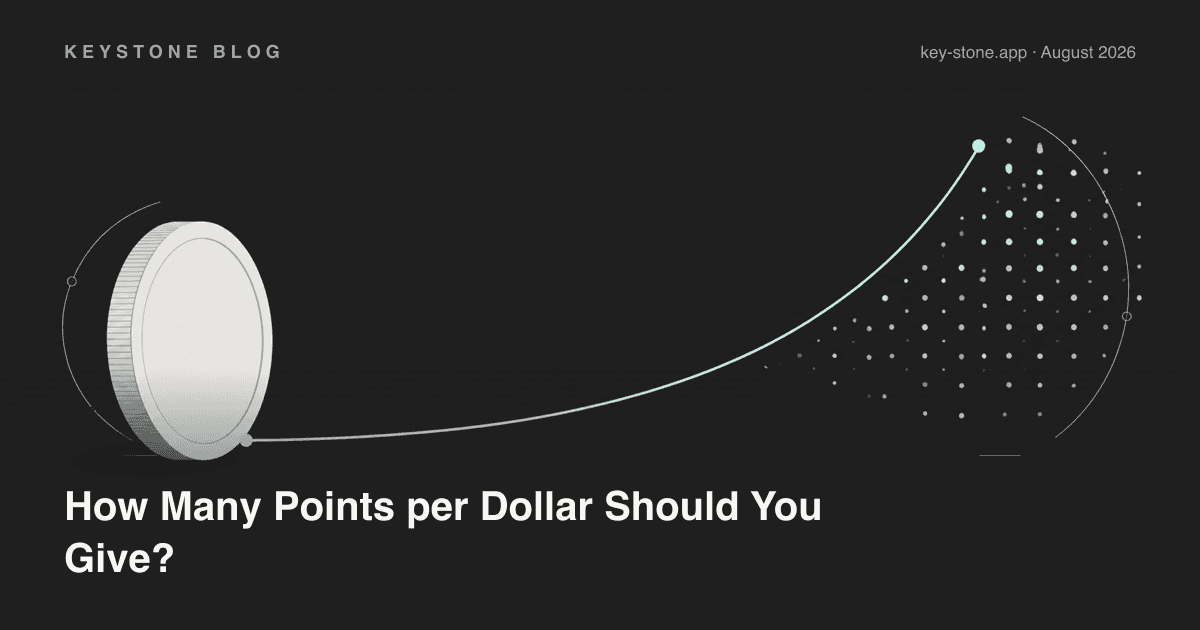
Ask ten Shopify merchants how many points they give per dollar and you'll hear ten different answers: 1, 5, 10, even 100. Here's the truth that makes the question easier: the number itself is arbitrary. A store giving 1 point per dollar can run exactly the same program as a store giving 100 points per dollar - the points are just a currency you invented, and you control the exchange rate.
What actually matters is your effective return rate: the percentage of every order you hand back as reward value. That's points per dollar multiplied by the value of each point. As common practice, most stores tune this to somewhere between 3% and 5% back - more if margins are fat and repeat purchases are the whole business model, less if margins are thin. Set the return rate first, then pick whatever point numbers make it feel good.
The Number Is Arbitrary - the Return Rate Isn't
The formula is one line:
Effective return rate = points earned per $1 x dollar value of one point
Say you give 5 points per dollar and 100 points redeem for a $1 discount. Each point is worth one cent, so your return rate is 5 x $0.01 = 5%. A customer spending $200 over a few orders earns 1,000 points - a $10 reward. That's the real economic promise of your program, and it's the number that has to survive contact with your margin.
Work backward from margin, not forward from a points number that sounds nice. If your gross margin is 60%, a 5% return rate costs you a twelfth of your gross profit on loyalty-attributed orders - usually a good trade for repeat purchase behavior. If your margin is 25%, that same 5% eats a fifth of your gross profit, and you should be closer to 1.5-2%.
The Three Variables You're Actually Setting
Every points program is three dials, not one:
- Points per dollar - the earn rate. Cosmetic on its own; it only means something combined with the next dial.
- Redemption value - how many points convert to how many dollars off. This is where the real cost lives.
- Minimum redemption threshold - the smallest reward a member can claim. This controls how fast the program starts feeling real.
The third dial is the one most stores get wrong. A useful rule: a typical customer should reach their first reward within one to two average orders. If your average order value is $60 and you give 5 points per dollar, an order earns 300 points - so a first reward around 300-500 points keeps the promise reachable. Set the threshold at 2,000 points and most members will churn out of the program before they ever taste a redemption.
Worked Examples at Three Margins
High-margin beauty brand (about 70% gross margin, frequent repurchase). Target a 5% return: give 10 points per dollar, let 200 points redeem for $1 (10 x $0.005 = 5%). A $45 skincare order earns 450 points - already past a 400-point first reward. The generous rate is affordable because the margin absorbs it and the category rewards habit.
Mid-margin apparel store (about 50% margin). Target 3-3.5%: give 5 points per dollar with 150 points per $1 (5 x $0.0067 = 3.3%). An $80 order earns 400 points, and a 300-point threshold means the first reward unlocks on order one.
Slim-margin food or electronics store (25-30% margin). Target 1.5-2%: give 5 points per dollar with 300 points per $1 (5 x $0.0033 = 1.7%). Here the program's job isn't showering value - it's giving repeat buyers a reason to consolidate purchases with you instead of a marketplace. Pair the modest base rate with occasional multiplier events for excitement.
Notice all three stores could describe themselves as giving "5 or 10 points per dollar." The customer-facing number is similar; the economics are completely different. If you want to test your own combination, the points value calculator on our tools page does this math interactively - earn rate, point value, threshold, and what it costs you per hundred orders.
Why 10 Points per Dollar Beats 1 Point per Dollar
Since the exchange rate is yours to invent, use psychology. Balances denominated in bigger numbers feel more substantial: 450 points reads as progress, while 4.5 points reads as a rounding error - even when they're worth the same dollar amount. That's why airlines deal in thousands of miles.
Two guardrails keep big numbers from becoming confusing:
- Keep the mental math easy. "100 points = $1" is instantly understandable. "175 points = $0.85" is not. Round conversion rates get redeemed more because members can price their own balance at a glance.
- Don't inflate past usefulness. 10 points per dollar hits the sweet spot for most stores. At 500 points per dollar the numbers stop meaning anything, and your reward table starts looking like a currency crisis.
Expiry and Breakage Change What the Program Really Costs
The return rate you calculated above is the ceiling on cost, not the actual cost - because a meaningful share of points is never redeemed. Points sitting in abandoned accounts, balances below the threshold, customers who moved on: that unredeemed share is called breakage, and it quietly discounts your program's real cost below the sticker rate.
Points expiry is how you manage this deliberately instead of accidentally. A 12-month expiry window with warning emails does two jobs at once: it caps the liability sitting on your books, and the "your points expire in 14 days" notification is one of the most reliable re-engagement emails a store can send - it converts dormant value into a deadline. In Keystone Loyalty, points expiry with automatic notifications is included from the $14.99 Starter plan (as of August 2026), so this isn't an enterprise-only lever.
The rule of thumb: never set your base earn rate assuming 100% redemption, and never rely on breakage so heavily that the program only works if customers forget about it. A program designed around non-redemption is just a marketing expense with extra steps.
Want More Excitement? Use Multipliers, Not a Higher Base Rate
When a program feels stale, the tempting fix is raising the earn rate. Resist it - a base-rate increase is permanent, margin-eating, and invisible within weeks because members simply adjust to the new normal. Multipliers give you the same excitement on a schedule you control:
- Double-points events - a weekend at 2x creates urgency and a spike you can measure, then the rate returns to normal.
- VIP tier multipliers - your top tier earns 1.5x or 2x permanently, but only your best customers qualify, so the extra cost lands exactly where the extra lifetime value is.
- Category or campaign boosts - 3x points on a new collection launch moves attention without repricing the whole program.
This is also the honest answer to "our competitor gives more points per dollar." Let them. A well-run 3.5% program with tiers and events beats a flat 6% program on retention, and it costs almost half as much.
The Mistakes That Quietly Kill Redemption
- A return rate below about 1%. Members do the math faster than you think. If $500 of spending earns a $4 reward, the program reads as an insult and silence would have been better.
- Thresholds that take four or five orders to reach. The first redemption is the moment a member starts believing in the program. Delay it past two orders and most never get there.
- Changing the exchange rate quietly. Devaluing points without notice is the fastest way to turn your best customers into public critics. If you must reprice, announce it, honor existing balances at the old rate for a window, and explain why.
- Ignoring margin variance across your catalog. If a third of your revenue is low-margin bundles, either exclude them from earning or set the sitewide rate to survive them.
- Letting points stack with every discount. Points earned on already-discounted orders at full rate doubles your promotional cost on exactly the orders that could least afford it.
Set the return rate from your margin, make the numbers feel generous, let expiry and multipliers do the fine-tuning - and revisit the math twice a year as your margin and AOV move.
Related reading
- How to price loyalty rewards without killing your margin
- How to get customers to actually redeem their points
- When should loyalty points expire?
If you want VIP tiers, points expiry, and bonus campaigns without enterprise pricing, Keystone Loyalty includes VIP tiers on its $69 Standard plan (as of August 2026) - roughly a third of what big-name loyalty apps charge for the same feature. See how it works at key-stone.app/loyalty.