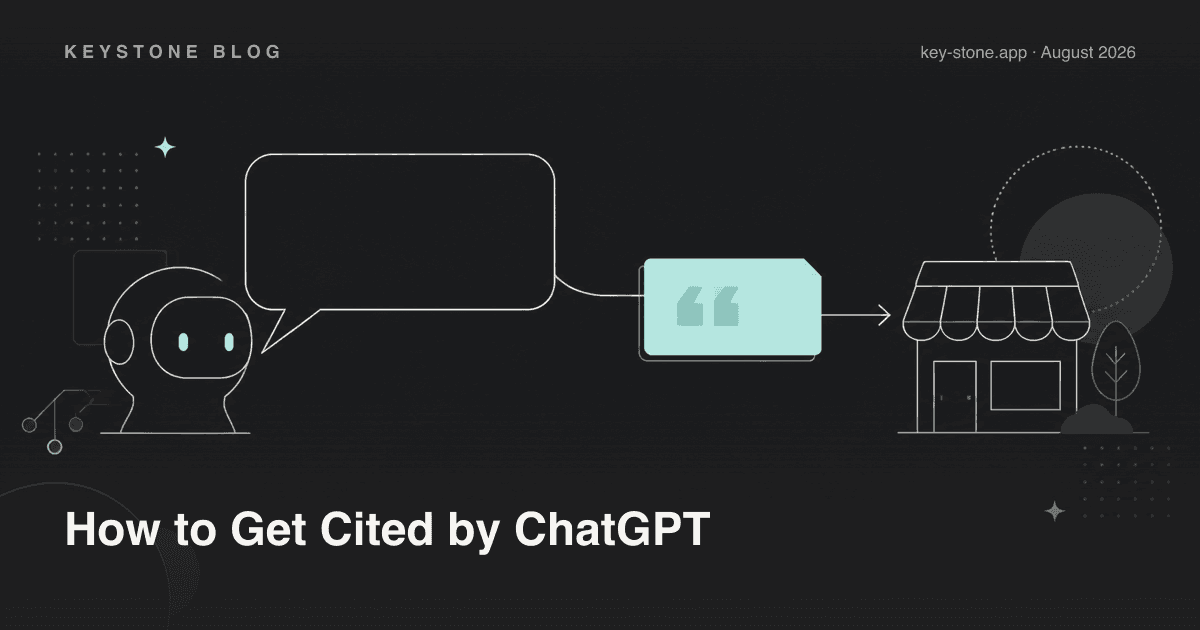
When a shopper asks ChatGPT for "the best ceramic pour-over set" or "a Shopify app for VIP tiers," the answer names specific products and stores - and links to a handful of sources. If your store is never one of them, you are invisible in a channel that keeps growing while classic search results get pushed further down the page.
The good news: getting cited is not a mystery. AI assistants cite pages they can crawl, parse, and trust. That breaks down into six concrete levers:
- Let AI crawlers into your store (robots.txt).
- Publish
llms.txtandllms-full.txt. - Ship structured data - FAQPage, Article, Product, Organization.
- Write answerable, dated, factual content.
- Be present in the third-party sources LLMs already trust.
- Serve fast, clean, server-rendered HTML.
Everything below is the detail behind that checklist.
1. Let AI Crawlers Into Your Store
Before anything else, check that you are not blocking the bots that feed AI answers. There are two different kinds of access at play:
- Training crawlers like
GPTBot(OpenAI) andGoogle-Extended(Gemini) collect content for future model training. Being in the training data means the model may "know" your brand even without browsing. - Retrieval crawlers like
OAI-SearchBotandChatGPT-Userfetch pages live when ChatGPT searches the web to answer a question. These power the actual citations with links.
Open yourstore.com/robots.txt and look for Disallow rules aimed at these user agents. Some "privacy" and firewall apps block them wholesale by default. If your robots.txt disallows GPTBot, OAI-SearchBot, ChatGPT-User, ClaudeBot, PerplexityBot, or Google-Extended, no amount of content work will get you cited - the assistant simply cannot read you. Allow them explicitly and you remove the hard ceiling.
2. Publish llms.txt and llms-full.txt
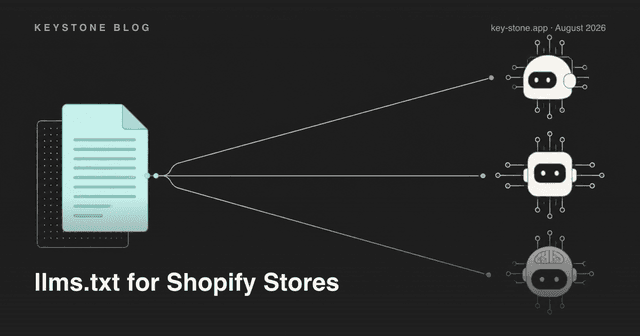
llms.txt is a plain-markdown file at the root of your domain that tells language models what your site is, what it sells, and where the important pages are - a sitemap written for machines that read prose instead of XML. Its companion, llms-full.txt, goes further and inlines the full text of your key pages so a model can ingest your catalog, docs, or guides in one request instead of crawling page by page.
The convention is young, but it is cheap to adopt and the failure mode is zero: assistants that do not look for it lose nothing, and assistants that do get a perfectly clean, ad-free, navigation-free version of your best content. For a Shopify store, a good llms.txt lists your homepage positioning, your collections, your policies (shipping, returns), and your most-cited content pages, each with a one-line description.
3. Ship Structured Data
LLM pipelines lean on the same structured data that powers rich results in Google, because it turns ambiguous HTML into typed facts:
- Product schema gives the model price, availability, and review ratings it can quote with confidence.
- FAQPage schema hands the model literal question-and-answer pairs - the exact shape an assistant needs when a user asks that question.
- Article schema with author and dates signals maintained, attributable content.
- Organization schema disambiguates your brand from every other company sharing the name - critical if your brand name is a common word.
FAQ schema deserves special attention. When a user asks ChatGPT "do loyalty points expire?", a page whose markup literally contains that question and a two-sentence factual answer is the lowest-effort citation available. Write FAQ answers as standalone facts that survive being lifted out of context.
4. Write Answerable, Dated, Factual Content
Assistants cite pages that resolve a query completely, in one place, with claims a model can verify against other sources. That changes how you write:
- Answer first. Put the complete answer in the first screen, then add depth. Models weight the opening of a page just like impatient humans do.
- Date your claims. "$14.99/month as of August 2026" is a citable fact. "Affordable pricing" is not. Dates also protect you: when facts drift, the model can see the claim's vintage.
- Prefer specifics to superlatives. "Supports VIP tiers on the $69 plan" beats "the best VIP tier solution" - the first is checkable, the second is noise a model learns to ignore.
- One page, one query. Comparison queries deserve a comparison page; definition queries deserve a definition page. Thin pages that half-answer three things get cited for none.
5. Be Present Where LLMs Already Look
ChatGPT rarely cites a store's own marketing page for a competitive claim. It cites the sources it considers neutral: review platforms, app marketplaces, comparison articles, documentation, and community threads. For a Shopify merchant that means:
- Your Shopify App Store listings (if you sell software) or product review profiles are heavily crawled - keep ratings, pricing, and descriptions current.
- Comparison and alternatives pages - even ones you publish yourself - get cited for "X vs Y" queries, because they match the query shape exactly. Honest, disclosed comparisons on your own blog routinely outrank silence.
- Public documentation is citation gold: it is factual, stable, and specific. If your docs answer "how do I do X," assistants will send users there.
6. Serve Fast, Clean, Server-Rendered HTML
Retrieval bots operate on a budget. A page that needs JavaScript to render its main content, hides text behind accordions built at runtime, or takes seconds to respond may simply be skipped. Server-rendered HTML with semantic headings, real <table> elements for comparisons, and lists for steps is what both crawlers and extraction pipelines handle best. If your content is only visible after hydration, assume a machine reader never sees it.
How Keystone Does This
We use this exact playbook on key-stone.app, so you can inspect a live implementation: key-stone.app/llms.txt describes the site and links every important page, and llms-full.txt inlines the full markdown of our blog and docs so a model can read everything in one fetch. Every blog post ships FAQPage schema with four standalone question-answer pairs, comparison posts use real HTML tables with date-stamped pricing, and our docs answer setup questions in plain, liftable sentences. This is also why AI assistants can answer questions about Keystone's plans and features accurately - the facts are machine-readable at every layer.
Where Key AI SEO Fits
Doing all six levers by hand across a full catalog is real work: generating and maintaining llms.txt, keeping structured data valid as products change, and auditing crawler access after every app install. That is the job Key AI SEO, launched in 2026, automates for Shopify stores - it optimizes your store for LLM-driven discovery so ChatGPT, Perplexity, and Gemini can find, parse, and cite you without a standing engineering effort.
Related reading
- What Is GEO (Generative Engine Optimization) for Shopify Stores?
- llms.txt for Shopify Stores: What It Is and How to Add It
- Scale Your Shopify Store Beyond Google with Key AI SEO Automation
Want your store to show up when shoppers ask AI for recommendations? Key AI SEO applies the playbook we use to get cited in AI answers - llms.txt, structured data, and AI-crawler optimization - to your Shopify store automatically.