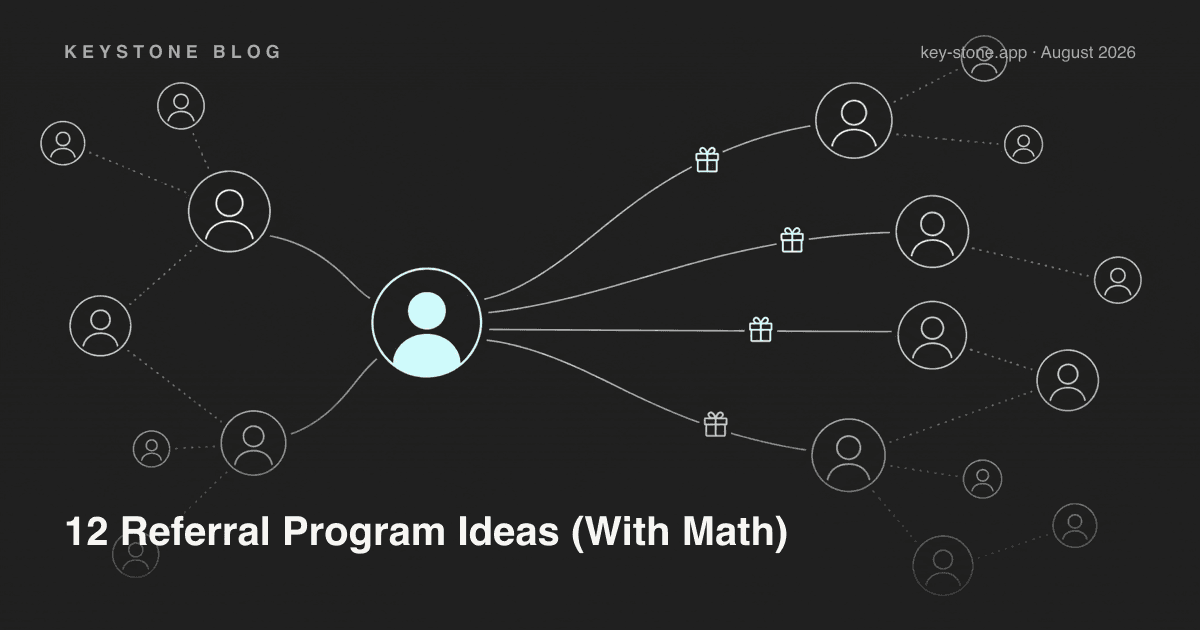
Every referral program comes down to one equation: cost per referred customer = advocate reward + friend reward actually redeemed. If that number is lower than what you pay for a customer through ads - your blended CAC - the program makes money. That's the whole test. A referral doesn't need to be clever; it needs to beat your paid channel.
Here are twelve referral program ideas that pass that test in different situations, each with the math. All examples use the same baseline store so you can compare: assumptions, not statistics - AOV $60, gross margin 40% ($24 gross profit per order), paid CAC $30. Swap in your own numbers, or run them through our free referral program planner.
1. The classic: give $10, get $10
The friend gets $10 off their first order; the advocate gets $10 off their next one. Worst case both redeem: $20 per acquired customer against a $30 CAC - you save $10 and the advocate's reward only costs anything if they come back and buy again, which is the point.
Fits: almost any store with AOV above ~$50. Fraud check: set a minimum order value above the reward ($30+ here) so a $10-off code can't be farmed on $12 orders.
2. Asymmetric: the friend gets more
Give the friend $15 and the advocate $5. The friend's discount is what converts a stranger; the advocate mostly needs acknowledgment, not payment. Total cost $20 - same as the classic - but the friend-side conversion rate rises because $15 off $60 is a 25% first-order discount.
Fits: stores whose bottleneck is friend conversion, not advocate sharing.
3. Points instead of cash for the advocate
The friend still gets a discount; the advocate earns 500 points worth $5. Two things make points cheaper than cash: not everyone redeems, and redeeming requires another purchase. If 70% of advocates redeem (your number will vary - watch it), the expected advocate cost is $3.50, and every redemption is attached to a new margin-bearing order.
Fits: any store already running a points program. This is the default we recommend.
4. Free product as the reward
A "$25 value" gift costs you COGS, not retail. At 40% margin, that $25 product costs $15 - the advocate perceives $25 of generosity for $15 of cost. Choose a low-COGS, high-perceived-value item (sample sizes, accessories, bestseller minis).
Fits: brands with strong own-product desire. Watch: shipping the gift adds real cost - bundle it with the advocate's next order instead of shipping it alone.
5. Free shipping for both sides
If your average shipping cost is $7, a both-sides free-shipping referral costs about $14 total - cheaper than the classic - and it removes the single most common checkout objection for the friend.
Fits: consumables and repeat-purchase categories where a discount would just erode margin on an order that was coming anyway.
6. Tiered milestone referrals
Three friends = $15 credit, five friends = a free product, ten friends = VIP status for a year. Most customers refer zero or one friend; a small group refers many. Milestones concentrate your budget on the advocates who actually move the number, instead of paying everyone the same flat rate.
Math: if the ten-friend tier costs you $60 in rewards, that's $6 per acquired customer - one fifth of the $30 CAC. Fraud check: milestone advocates are exactly where self-referral shows up; match on payment fingerprint and shipping address, not just email.
7. VIP-tier-exclusive referral multiplier
Your top loyalty tier earns double referral points. The extra cost lands only on customers who already have the highest lifetime value, and the perk itself becomes a reason to climb tiers. It's a referral idea and a tier benefit in one line item.
Fits: stores running VIP tiers. If you're not yet, tiers plus referrals is the strongest pairing in loyalty.
8. Seasonal double-referral events
Run "double referral rewards" for two weeks, twice a year - before your peak season, not during it. A deadline turns "I'll share it sometime" into action now. Cap the event budget in advance: if doubled rewards cost $40 per acquisition, you're still under a $30 CAC only if the friend's second order arrives, so treat event acquisitions as a two-order payback, and measure them that way.
9. The thank-you page ask
This one costs nothing extra - it's about timing. The moment after checkout is peak enthusiasm: the customer just voted for you with money. Put the referral link on the order confirmation page with a one-line pitch. Same reward as your standing program, materially more shares, zero added reward cost.
10. Stack the referral with the welcome offer
The friend gets the $10 referral and your standard 10% first-order discount. On a $60 order that's $16 off - a 27% acquisition discount, leaving $8 of gross profit on the first order at our baseline margin. That's acceptable only because the real return is the second order. Run this stack when you can see repeat purchase rates; kill it if referred customers don't come back.
Fraud check: stacked codes leak to coupon sites fastest - use unique single-use codes with expiry, never a shared code.
11. B2B and wholesale: account credit
A wholesale customer refers another business; when the new account places its first order of $1,000+, the referrer gets $100 of account credit. Credit (not discount) means the reward is only spendable on a future order - retention is built into the mechanic. At a 30% wholesale margin, the referred order carries $300 of gross profit against a $100 credit that itself triggers more purchasing.
12. Charity donation per referral
"We donate $5 for every friend you refer." The cost is fixed and known, there's no discount for coupon hunters to farm, and for values-driven brands it often out-shares a cash reward. Pair it with a small friend-side discount so the friend still has a first-order reason to buy.
Picking one: the short version
Start with points-for-the-advocate plus a cash discount for the friend (idea 3), announce it on the thank-you page (idea 9), and add milestones (idea 6) once you can see who your super-advocates are. Model your own numbers in the referral program planner before you launch - the difference between a profitable and an underwater program is usually one assumption.
In Keystone Loyalty, referrals are available from the $14.99 Starter plan (as of August 2026), with unique codes, minimum order values, and reward rules you can change without touching your theme.
Related reading
- The real reason referral programs fail quietly
- How to reward friends-and-family referrals without sacrificing margin
- Why refer-a-friend should be the first reward, not the last
Want referrals, points and VIP tiers in one app? Keystone Loyalty gives you VIP tiers at a third of big-name pricing - referral program included from the Starter plan.