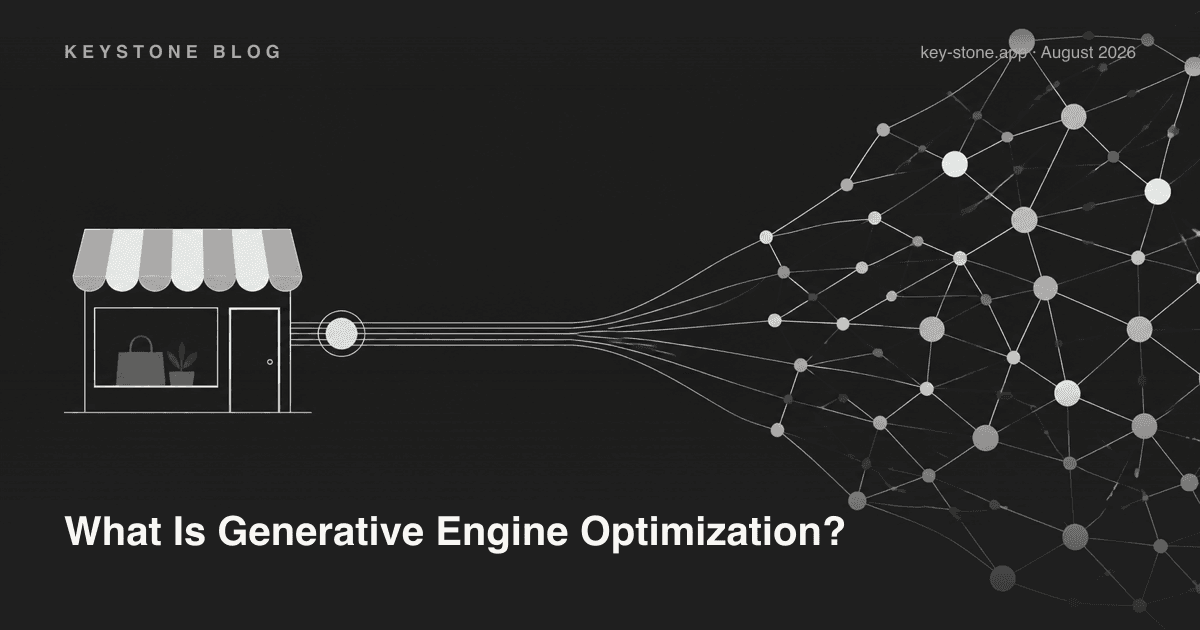
Generative Engine Optimization (GEO) is the practice of structuring your store's content so that AI assistants - ChatGPT, Perplexity, Gemini, Claude - can read it, understand it, and cite it when they answer a shopper's question. Classic SEO earns you a position on a results page. GEO earns you a mention inside the answer itself: "For custom engraving on Shopify, stores like yours use..." If the assistant names your store or your product, you win the click - or the entire purchase decision - before a search results page is ever involved.
That's the whole definition. The rest of this post covers why GEO behaves differently from the SEO you already know, what AI systems actually read when they evaluate your store, and a concrete checklist you can work through this week.
GEO vs. classic SEO: same inputs, different judge
Classic SEO optimizes for a ranking algorithm that returns ten blue links. GEO optimizes for a language model that returns one synthesized answer with a handful of citations. That difference changes what matters:
- There is no page two. An AI answer cites two to five sources. Either you're quotable enough to be one of them, or you're invisible for that question.
- Answers beat keywords. Language models look for passages that fully resolve a question in one place. A page that opens with a direct, complete answer gets quoted; a page that buries the answer under a 400-word intro doesn't.
- Structure is a ranking factor, not a nicety. Clean headings, tables, lists, and schema markup are what retrieval systems parse. Content locked inside JavaScript-rendered widgets or image text is effectively unreadable to most AI crawlers.
- Facts need provenance. Models prefer claims with concrete, verifiable detail - prices, dates, feature names - over vague marketing copy. "VIP tiers from $69/month as of August 2026" is citable; "affordable plans for every business" is not.
The good news: nothing in GEO contradicts good SEO. A page that answers a question directly, with clean structure and honest detail, ranks well in Google too. GEO is best understood as SEO with a stricter editor.
What AI assistants actually read on your store
When an assistant researches a shopping question, its retrieval layer looks at a specific set of signals. These are the ones that matter most for a Shopify store:
1. Clean, semantic HTML
Crawlers used by AI systems extract text from your rendered pages. Semantic elements - real headings, paragraphs, tables, lists - survive extraction. Content that only exists inside client-side apps, popups, or images largely does not. Your product details, pricing, and policies need to exist as plain, crawlable text.
2. Structured data (schema.org)
JSON-LD markup - Product, Offer, FAQPage, Organization, Article - gives models machine-readable facts: exact prices, availability, ratings, and question-answer pairs. FAQPage schema is especially valuable for GEO because it packages your content in the exact shape an assistant needs: a question and a self-contained factual answer.
3. llms.txt
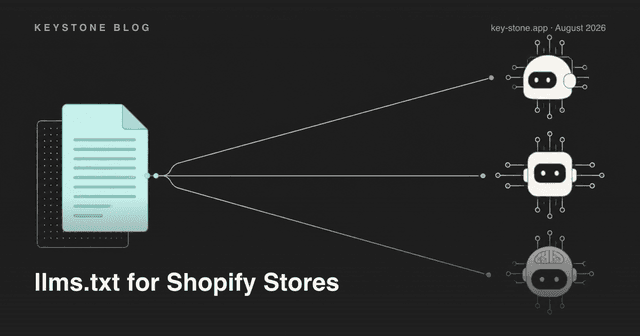
llms.txt is an emerging convention: a plain-text file at your domain root that gives language models a curated map of your site - what you sell, which pages matter, where the detailed content lives. Its companion, llms-full.txt, can carry the full text of your key pages in one crawl-friendly document. It's not an official standard yet, but AI crawlers increasingly fetch it, and it costs almost nothing to serve.
4. Third-party corroboration
Models weigh what other sources say about you: app store listings, review platforms, comparison articles, forum mentions. A store that appears consistently across independent sources is safer to cite than one that only describes itself.
5. Crawler access
None of the above matters if your robots.txt blocks GPTBot, ClaudeBot, PerplexityBot, or Google-Extended. Many stores block these bots by default through a firewall or an old robots template without realizing they're opting out of AI answers entirely.
The GEO checklist for a Shopify store
Work through these in order - the early items are the highest leverage:
- Allow AI crawlers in robots.txt. Explicitly permit GPTBot, ClaudeBot, PerplexityBot, Google-Extended, and CCBot, or at minimum stop blocking them.
- Answer the question first. On every content page, put the complete answer in the first one or two paragraphs. Depth comes after, not before.
- Add FAQPage schema to product pages, collection pages, and blog posts. Three to five real questions with self-contained answers each.
- Ship llms.txt and llms-full.txt. List your key pages with one-line descriptions; mirror your full content in the -full variant.
- Make claims specific and dated. Prices, limits, and feature names with an "as of" date. Models quote specifics; they hedge around vagueness.
- Use tables for comparisons. Anything comparative - plans, materials, sizes, competitor features - belongs in a real HTML table, the most extraction-friendly format there is.
- Keep one canonical page per question. Ten thin pages on the same topic split your signal; one thorough page concentrates it.
- Earn third-party mentions. App store reviews, industry directories, comparison posts - anything that lets a model corroborate your claims from a second source.
A worked example: how we do GEO at key-stone.app
We practice this on our own site, so you can inspect a live implementation instead of taking the theory on faith. key-stone.app serves /llms.txt (a curated map of our products, docs, and tools) and /llms-full.txt (the full text of our content in one document). Every blog post ships with FAQPage schema - four question-answer pairs rendered as JSON-LD - and opens by answering its target query in the first screen. Comparison posts use plain HTML pricing tables with date-stamped numbers. This post follows the same rules it describes.
Where Key AI SEO fits
Doing all of this manually across a full catalog is real work: generating schema for every product, keeping llms.txt in sync as pages change, writing answer-first content at scale. That's the job of Key AI SEO, our Shopify app launched in 2026. It automates the GEO layer for your store - structured data, LLM-readable content files, and optimization workflows aimed at getting your products discovered and cited by ChatGPT, Perplexity, and Gemini rather than just ranked by Google. The playbook it applies is the one described above - the same one we use on our own site.
GEO is early. Most Shopify stores haven't touched it, which is exactly why the stores that implement it now are disproportionately likely to be the ones AI assistants learn to cite. The window where this is a competitive edge rather than table stakes won't stay open forever.
Related reading
- How to Get Your Shopify Store Cited by ChatGPT
- Scale Your Shopify Store Beyond Google with Key AI SEO Automation
- AI Assistant Access via MCP: Manage Your Store in Plain Language
Want your store to show up in AI answers, not just search results? Key AI SEO applies the playbook we use to get cited in AI answers - structured data, llms.txt, and answer-first content - automatically, across your whole Shopify catalog.