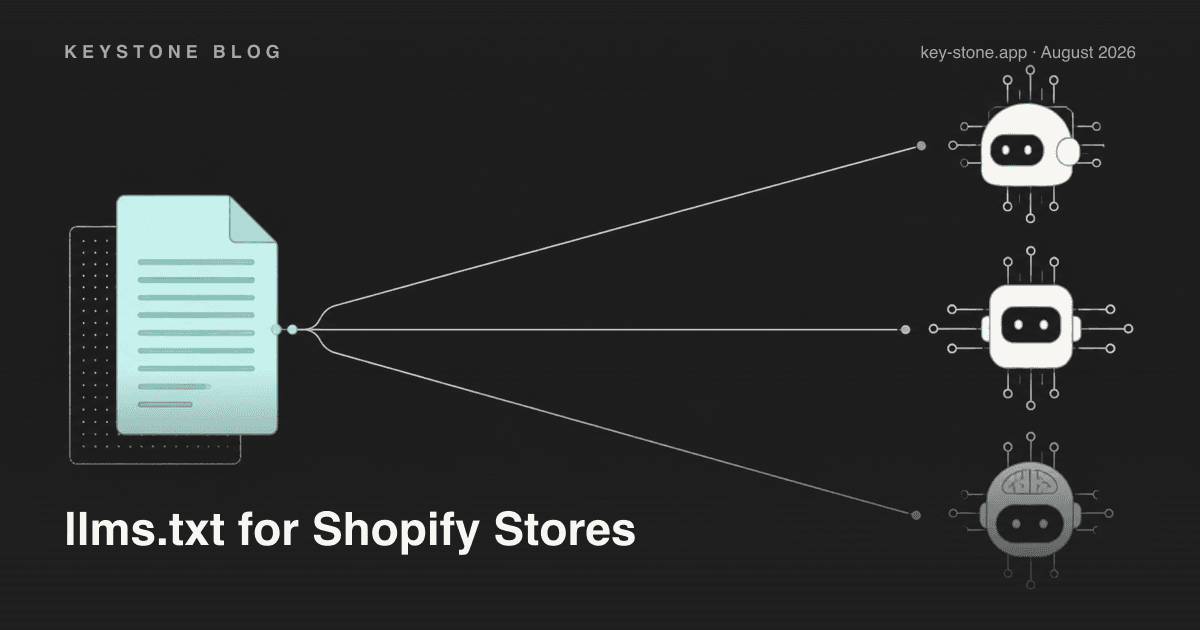
llms.txt is a plain-markdown file that lives at the root of your domain - yourstore.com/llms.txt - and gives AI systems a curated, machine-readable summary of what your site is about and where its most important pages live. It was proposed in September 2024 by Jeremy Howard of Answer.AI as a convention for making websites legible to large language models, the same way robots.txt made them legible to search crawlers. For a Shopify store, it is the cheapest single step you can take toward being understood - and eventually cited - by AI assistants like ChatGPT, Perplexity, and Claude.
There is one catch: Shopify does not let you upload arbitrary files to your domain root, so adding llms.txt takes either an app or a proxy in front of your domain. This guide covers what the file is, what a store should put in it, and the realistic ways to serve it.
What llms.txt actually is
The format is deliberately simple. It is a markdown document with:
- An H1 with the name of your site or business.
- A blockquote containing a one-paragraph summary of what you do.
- Sections of links, each with a one-line description of what lives behind the link.
That is the whole spec. The point is curation: instead of forcing an AI system to crawl hundreds of theme-rendered pages and guess which ones matter, you hand it a short, prioritized reading list in a format language models parse natively.
The convention also defines a companion file, llms-full.txt, which goes further: rather than linking out, it inlines the full text of your important content in one markdown document. An assistant that fetches it gets everything it needs to answer questions about your business in a single request, with no JavaScript rendering and no navigation.
Why your theme HTML is not enough
A typical Shopify product page is tens of thousands of tokens of HTML once you count the theme markup, scripts, tracking snippets, and app embeds wrapped around a few hundred words of actual product information. Language models work inside token budgets. When an AI assistant researches an answer, clean markdown that is 95% signal beats a JavaScript-heavy page that is 5% signal.
To be clear about where this stands: llms.txt is a young, voluntary convention, not an enforced standard. Some AI crawlers fetch it today, others do not yet, and nobody guarantees a citation because the file exists. But the cost of adding it is close to zero, the downside is none, and the stores that describe themselves clearly are the ones best positioned as AI-assisted shopping grows. Google Search, for what it is worth, does not use llms.txt for ranking - this file is aimed at AI assistants, and it complements rather than replaces your sitemap.xml and robots.txt.
What a Shopify store should put in its llms.txt
Think of it as the briefing you would hand a new employee on day one. A good store llms.txt contains:
- The summary blockquote - what you sell, who it is for, and where you ship. One paragraph, no marketing fluff.
- Core collections and bestsellers - links to your most important collection and product pages, each with a one-line description an assistant could quote.
- Policies - shipping times and costs, returns and exchanges, warranty. These are exactly the questions shoppers ask assistants.
- FAQs and guides - size guides, care instructions, compatibility notes.
- Contact and wholesale - how to reach you, and B2B terms if you have them.
Resist the urge to dump your entire sitemap into it. A 40-line curated file that an assistant can read in one pass is worth more than 4,000 undifferentiated URLs. Curation is the feature.
How to add llms.txt to a Shopify store
Here is the practical problem: Shopify serves theme assets from its CDN paths and app proxies under /apps/, and gives merchants no way to place a file at the domain root. So yourstore.com/llms.txt cannot be created from the theme editor. You have three realistic options:
- Use an app that generates and serves it. This is the path for most merchants. Key AI SEO, our AI search optimization app, generates llms.txt and llms-full.txt from your actual catalog, policies, and pages, serves them for your store, and keeps them in sync as products change - alongside the schema and content work that AI visibility needs.
- Serve it at the edge. If your domain sits behind a proxy or CDN you control (Cloudflare in front of your Shopify domain, or a headless storefront), you can intercept the /llms.txt path and serve the file directly. Full control, but it is a developer task and the file goes stale unless you automate regeneration.
- Host it at a subpath. You can publish the content as a page and link to it. This is a last resort - assistants look for the file at the root, so a non-standard location loses most of the value.
Whichever route you take, treat freshness as part of the job. An llms.txt that still lists last season's catalog teaches AI systems wrong answers about your store.
A live example: how we do it at Keystone
We run this playbook on our own site. key-stone.app/llms.txt is a curated markdown index of our product pages, documentation, and guides - short enough to read in one request. key-stone.app/llms-full.txt goes further and inlines the full markdown of every blog post we publish, so an assistant that wants to quote our loyalty pricing guide or our variant-limit walkthrough never has to fight our page templates to get it.
That is the same structure Key AI SEO builds for merchant stores: a curated index for orientation, a full-content file for depth, and automatic regeneration so neither drifts out of date.
The bottom line
llms.txt will not transform your traffic overnight, and anyone who promises that is selling something. What it does is make your store legible to the systems shoppers increasingly ask for recommendations - at near-zero cost. Write the summary honestly, curate the links, inline your policies, and keep it current. When an AI assistant next researches products in your category, be the store it can actually read.
Related reading
- What Is GEO (Generative Engine Optimization) for Shopify Stores?
- How to Get Your Shopify Store Cited by ChatGPT
- AI Assistant Access via MCP: Manage Your Loyalty Program from Claude
Want your store to show up when shoppers ask AI assistants what to buy? Key AI SEO applies the playbook we use to get cited in AI answers - llms.txt, structured data, and content built for generative engines - to your Shopify store.